It's Never Over
An unexpected foray into the history of slavery in western Pennsylvania

One thing I love about genealogy (my complaints to the contrary notwithstanding) is that it is never over. Even the research on your own family, if you’re lucky enough to have a few records to rub together. It never ends. Not because the data is infinite—it is not. Every paper trail will eventually run cold. We call it the “great span” of the past, but the historical period is really more of a yardstick. And we genealogists, even at our very dustiest, are only looking at a tiny sliver of recent human history.
No, it’s the fact that we ourselves are finite that makes all the difference. Even after we’ve stuffed our brains to the rafters with family anecdotes, there are more out there. Stuff a new one in and an old one pops out the back. As someone once said, each human life is a whole world. And genealogists try to contemplate a whole galaxy one planet at a time.
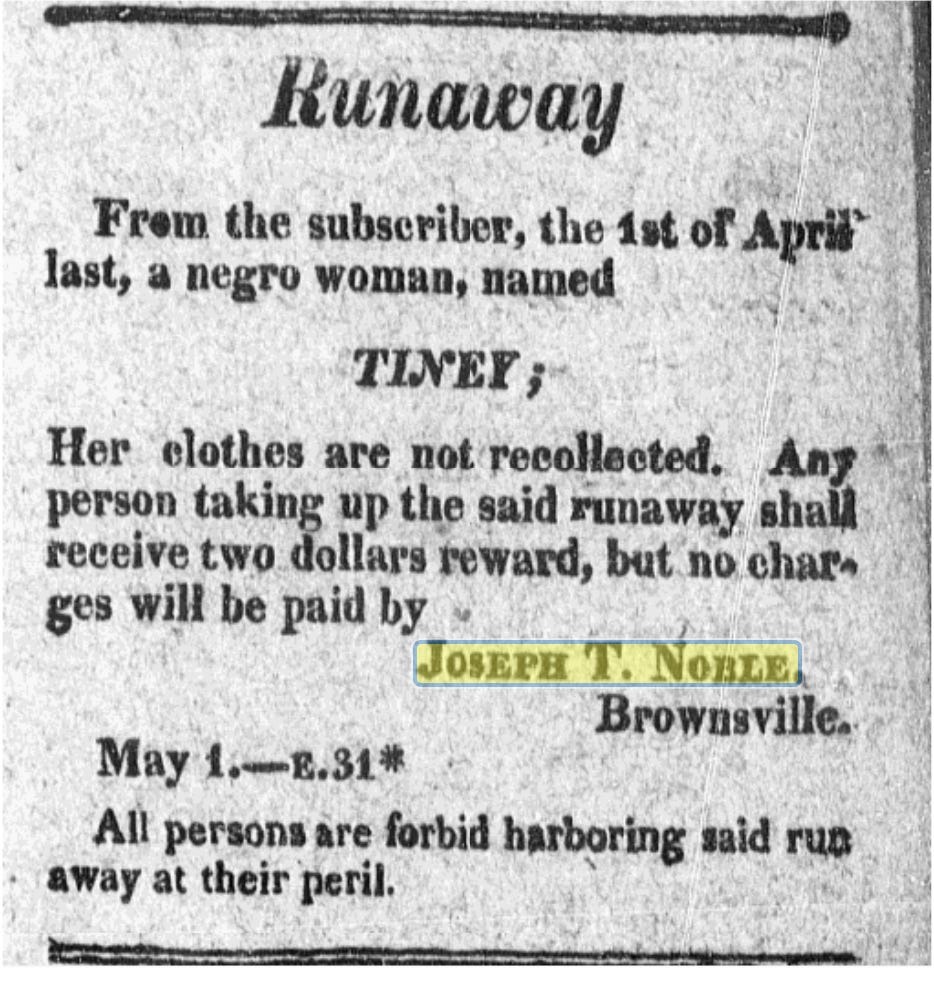
This, for instance, from 1817. Entirely new to me. You’ll recall1 I was researching this “Joseph Noble” character a while back. He was the boaster who claimed he and Andrew Jackson were old pals.
Joseph Noble was a Pennsylvanian but he was no Philadelphia gentleman. That wouldn’t be Andrew Jackson’s type. Noble was exactly the sort of fellow Jackson would have consorted with. He was a man of the frontier. A frontiersman, you might say. Western Pennsylvania, when Noble was born during the Revolution War, was a wild place.
His parents were Southerners, plantation owners, and slaveholders. Indeed, in 1780 Virginia still held a viable claim to the Noble properties in Fayette county. Back in 1767 a couple English gentleman, Messrs. Mason and Dixon, had surveyed the border between Maryland and Pennsylvania. But they’d stopped short of the Nobles, who were west of Fort Pitt, because their Native guides would go no further. Were the Noble plantations in Virginia, or were they in Pennsylvania? Depends who you asked. Borders in those early days were nebulous and squiggly.
That was all settled in the 1780s, and by 1817, Joseph Noble’s hometown of Brownsville was solidly under Pennsylvania government. And Pennsylvania passed an act for the gradual abolition of slavery in 1780. I know that because they called it “An Act for the Gradual Abolition of Slavery.” No forced acronyms in those days.
And yet, here’s Tiney. In 1817, 37 years later. Who was she?
Do not pay for a subscription if you think I’m going to solve this.
I’m not.