Genealogy Doesn't Matter.
When the legend becomes fact, print the legend.

I.
Imagine being so bent out of shape about a 500-year old lawsuit that you name your son after it. If you find that reasonable behavior, you would have gotten along with Victor Grosvenor, Earl Grosvenor, and also with his son, “Bendor” Grosvenor, 2nd Duke of Westminster. And bully for you, because your new friends were filthy rich, and their descendants still are, owning as they do a significant percentage of the choicest real estate in London.
As you will have noted, “Bendor” was just a nickname, but it’s what everyone called him. His real name was Hugh Grosvenor.
Here’s how his wife Loelia put it in her memoirs:
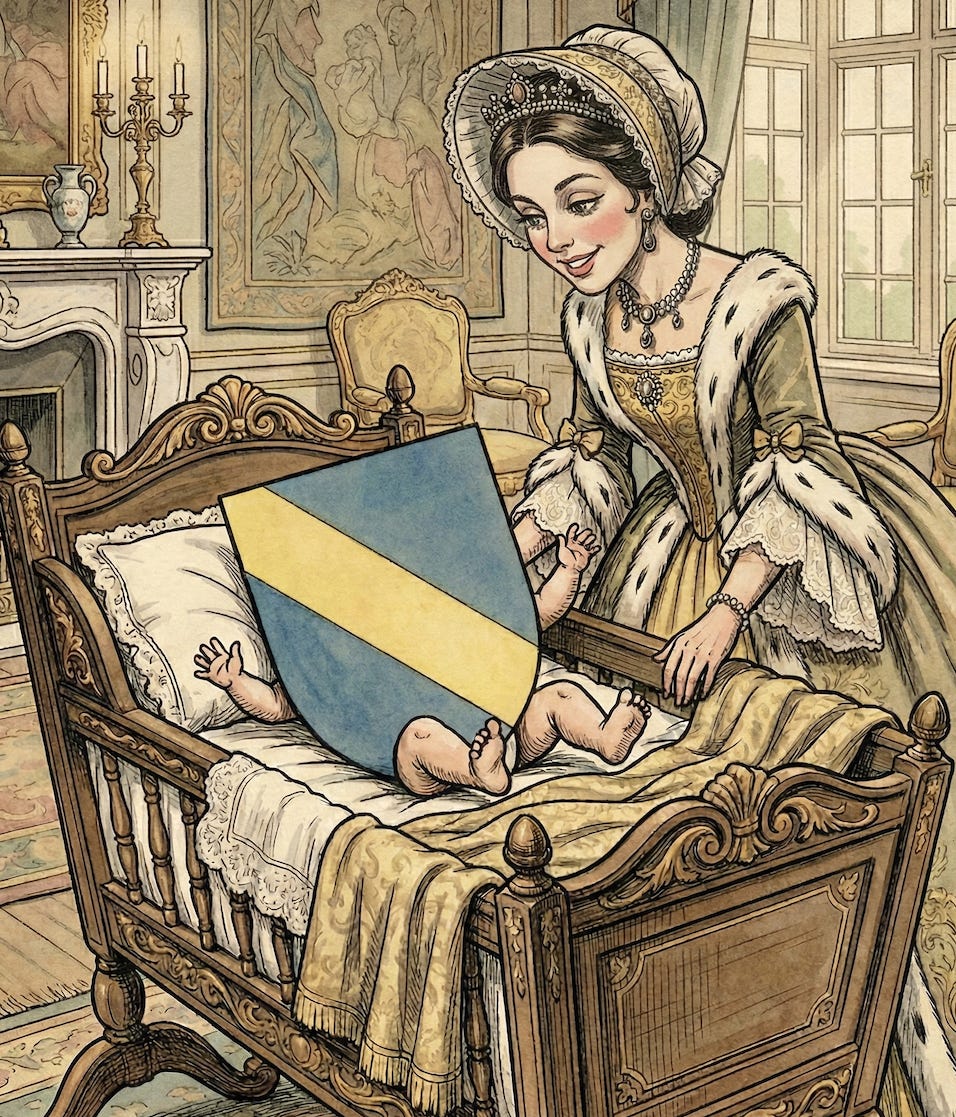
[T]he mediæval Grosvenors are chiefly famous for being involved in the great Scrope v. Grosvenor case in the reign of Richard II. It began in 1385 when Lord Scrope, being with the Army in Scotland, complained that Sir Robert Grosvenor was using the Scrope arms, Azure, a Bend Or, (a gold diagonal stripe on a blue ground). He had already accused one Carminow of Cornwall of the same offence, but the Cornishman had been able to convince a jury of six knights that he had borne this device since the days of King Arthur and had continued to use it. Sir Robert was not so fortunate. The case was tried in the Court of Chivalry presided over by Thomas, Duke of Gloucester, and it went on for four years and in the end Sir Robert had to pay the costs which amounted to £466 13s. 4d. Depositions were taken from witnesses all over England who attested that they had seen the arms used in battle or on seals or in stained-glass windows. John of Gaunt was caught at Plymouth just as he was about to embark for Spain and he gave evidence in favour of Scrope. So too did the future Henry IV, and also Harry Hotspur. One knight aged 105 deposed that he had seen Scrope bear the arms at Crécy and Poitiers and other battles. The poet Chaucer, who had a finger in every pie, came down on the side of his old friend Scrope, though he candidly admitted that he had once been walking down Friday Street in London and had seen an inn with a sign on which was painted the disputed arms and had been told that they were put there, not for Scrope, but for Grosvenor.
Lord Scrope was an important person at the Court and had been Chancellor of England and his opponent was a comparatively unknown country gentleman, but all the same, nearly sixty people were found to testify in Sir Robert's favour, including Owen Glendower, the great Welsh nationalist, who stoutly affirmed that it was well known on the Welsh border that the arms belonged to the Grosvenors. In the end the Duke of Gloucester decided that Scrope should keep the Bend Or and that Grosvenor could have an inferior version, Azure, a Bend Or, with a Plain Bordure Argent for Difference. This was not good enough for Sir Robert, so he appealed to King Richard II, who ruled that the arms were too similar to be borne by families which were not related by blood and that the Grosvenors should change to Azure, a Garbe Or (a gold sheaf). The arms of the Scrope and Grosvenor families remain to this day as King Richard decreed.
But the decision rankled. In 1880 the first Duke of Westminster won the Derby with a horse called Bend Or and his baby grandson, Hugh Richard Arthur, Lord Belgrave, got called Bend Or too—though why I have never heard explained. There must have been some family joke that has long since been forgotten. Of course everybody, even his parents and sisters, would normally have addressed the baby as 'Belgrave', so they may have thought that any nickname was preferable. At all events it stuck, and my husband's friends never called him anything but Bendor or Benny.
The name has since graduated to legal status. Rather unsporting of the richest peers in England, I should say. The Grosvenors made out far better in the last seven hundred years than the legal victors, the Scropes, and there’s no need to rub that in. The modern-day Scropes (pronounced “Scroop,” of course) have no hereditary titles, let alone title to most of Mayfair.
Sir Robert Grosvenor had to demonstrate the antiquity of his family before the heraldic courts. That’s the game, after all—whoever used the insignia longest is the winner. And he was up against a formidable opponent. Politically powerful, yes, but also of ancient name. The demonstrably antique “le Scropes” claimed descent from a pre-conquest magnate named Richard FitzScrob.1 Lord Scrope, an old soldier, also had John of Gaunt, the King’s very powerful uncle, on his side.
Sir Robert, however, could count on the support of his dutiful hometown friends, lords, and vassals. Sir Robert Grosvenor’s liege lord was the Abbot of Vale Royal (now a wedding venue, naturally), and in his learned opinion the first Grosvenor was a companion of the Conqueror—“my ancestors came over with the Conqueror” being the posh English version of “I was at Woodstock.”2
So, per the Abbot, one Sir Gilbert Grosvenor was at Yazgur’s farm—I mean, the Battle of Hastings. And was Gilbert himself some Norman parvenu, lacking distinguished kin? Au contraire. The abbot and other Cheshire luminaries had more to offer: Gilbert was nephew to none other than Hugh Lupus, the earl of Chester. Hugh Lupus, bosom buddy to William the Conqueror, was a magnate of great historical stature. These are the big genealogical guns.
Hugh Lupus was a Norman, no doubt. His mother was even reputed to be William the Conqueror’s half-sister.3 We know he was an imposing gentleman. Fierce, yes, hence “Lupus,” but, to quote Cokayne, “his career was chiefly notorious for gluttony, prodigality, and profligacy.” And so, during his lifetime, he was Hugh le Gros. “Lupus” was bestowed posthumously, perhaps in an attempt to restore a little dignity, or at least what passed for dignity in the Middle Ages. But remember that: Hugh, earl of Chester, was also known as Hugh le Gros. And it was a family tradition amongst the Grosvenors, a knightly family in Cheshire three centuries later, that their first English ancestor was Hugh’s nephew.
From there, the Grosvenor witnesses were able to trace a descent through eight generations to Sir Robert, the defendant. But at least up to Sir Robert’s great-grandfather, another Robert, the pedigree rested entirely on tradition, with no primary source forthcoming or even alleged to exist.
Tradition was good enough for the Grosvenors and everyone else for many years. Even though they lost the case, they treasured their descent from a nephew of Hugh Lupus.
That’s until modern genealogy came along.
II.
Scrope v. Grosvenor is more than an obscure heraldic squabble. It’s more, even, then the foundational historical wound of a very rich family. It is, in fact, one of the deepest foundational texts of modern, scientific genealogy. Recall that the ancient descent from Sir Gilbert was based on oral tradition. But Sir Robert’s line back to his own great-grandfather (another Sir Robert), was firmly founded in written sources, such as monastic charters, and indeed, it withstands scrutiny even today.
The English were using written records to prove their genealogies before 1385. There were land disputes, inheritance disputes, and of course other heraldic litigations. But Scrope v. Grosvenor gives us one of the earliest records of that method of genealogical argument to survive.4
The Abbot wasn’t all hot air. When he identified that first Grosvenor in England, he cited to the Domesday Book.
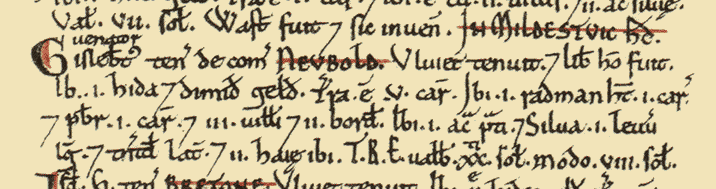
You can’t beat the Domesday Book for evidence of familial antiquity and distinction. And lo, “Gilbert Venator,” a lord of Cheshire, sure looks like the founder of the family. “Venator” is Latin for “Huntsman,” more or less, and “Grosvenor” is very plausibly a Norman French rendering of “Great Hunter.” So far as good. But alas, the Abbot commits one of the cardinal sins of genealogy: same name, same person.5
Gilbert “Venator” was not a mystery man waiting to be claimed. He was lord of several well-known properties in Cheshire (the text above refers to Newbold, which was just one of them), and those holdings can be precisely mapped to the known later holdings of one Gilbert de Venables and his descendants.
Venables is “veneur” + “abilis.” Able hunter. There was no Gilbert Grosvenor. There was only Gilbert de Venables, and there is no obvious reason to connect him to the Grosvenor family. He already had a name, and his family, or their vassals and successors, have carried it into the present day.
III.
There are genealogists, and there are genealogists. I’m the former. W.H. Bird was the latter. He was one of the great English researchers of the Edwardian era, limited, perhaps, by their exclusive interest in the nobility, but when you’re dealing with medieval records you don’t have much choice. W.H. Bird carefully but brutally dismantled the Grosvenor pretensions to Norman roots in April 1902, in the pages of the short-lived journal The Ancestor. I encourage you give it a read. It’s wonderful.
These guys were exquisitely bitchy about their disagreements, in the way that only people who care a whole lot about something that doesn’t matter at all can be.
One word of warning here to the author of Armorial Families. Strange to say, in his immaculate pages the bende dore still figures without protest as a paternal coat of Grosvenor; it is quartered also by descendants of a doubtful line, who differenced their sheaf with bezants. Is this wilful contempt, or can it be ignorance? Mr. Fox-Davies is, we know, a stickler for authority. Probably therefore it merely shows that he cannot boast the marvelous memory of Sir Bernard Burke, and is not aware of the two judgments I have mentioned. The Marshalsea has no more terrors; but I tremble to think of the vials of wrath ‘X’ may open upon his devoted head, should he become aware of the offence in all its enormity.
If that all sounds a little esoteric…well, of course it does. Did you get lost on your way to a different article? I’ll tell you what’s going on here, as best I can tell. But you probably had to be there.
Fox-Davies was a major heraldic authority in his day, and Armorial Families was a magnum opus if there ever was one. Bird is alleging that Fox-Davies ignored Scrope v Grosvenor and accorded the Grosvenor family the original bende dore in his heraldic dictionary. Outrageous! Then Bird notes acidly that Sir Bernard Burke (of Burke’s Peerage fame), who would famously print anything, with minimal regard to accuracy, would never have made the same mistake, thanks to his “marvelous memory.” Indeed, “X,” the pseudonym of another contemporary genealogist, would be filled with rage to hear of the oversight. But as the readership would have known, “X” was none other than Fox-Davies himself.
Anyway, exquisitely bitchy, like I said.
The bottom line is that Bird got his talons in the Grosvenor family traditions and he tore them apart. When he was done, the only line left standing was Sir Robert Grosvenor’s back to his own great-grandfather, another Robert, who died around 1386. No “Gilbert le Gros Venator,” no Hugh Lupus. It was all a fiction, says Bird, and he proved it.
IV.
Back to Bendor “Benny” Grosvenor. Benny’s real name, recall, was Hugh. Benny was a hard man, but he had a soft spot for the Nazis. He wasn’t alone among 1930s aristocrats, but I’m just saying. Don’t feel too badly for him. Benny had no male heirs, so the current Duke of Westminster, the head of the Grosvenor family, is a cousin, descended through his half-uncle. The current duke’s name is Hugh. The Grosvesnors are partial to the name Hugh.
I told you that Sir Robert Grosvenor contended that he was descended from a nephew of Hugh Lupus. And I told you that Bird demonstrated, definitively, that there was no evidence for that claim. That was in 1902. Benny was the duke in 1902. His father’s name was Hugh Lupus Grosvenor. So you can see the family had taken the tradition rather to heart. Some time between 1386 and the birth of Hugh Lupus Grosvenor in 1825, the stories started to blur together, and Hugh Lupus became the founder of the family, not just a illustrious relation. It’s easy enough to make the switch. Hugh le Gros, also known as Hugh Lupus. Hugh is a wolf, Hugh is “great.” He’s the great hunter! Le Gros Venor. If you have a family—I’m guessing you do—you know how these things go. Ornate, semi-accurate tradition (uncles, half-sisters) is not very memorable. Over the years, data is lost. You flatten it to the essentials: fathers and sons.
Thus, by the time Bird was writing, and probably long before, the Grosvenor family founder had morphed from Gilbert le Grosvenor, a nephew of Hugh, to Hugh himself. The Grosvenors themselves had risen from humble country gentry to the richest peers in the British Empire. Perhaps they felt a higher class of origin story was called for.
You may wonder whether Bird’s research had any effect. Did it squash the Grosvenor claims to Norman antiquity once and for all?
V.
When Gerald Grosvenor, the sixth duke of Westminster, died in 2016, here’s what the Guardian said:
The Duke’s ancestor Hugh Lupus – the king’s head huntsman or grand veneur, a tubby man nicknamed gros veneur, from which derived the family surname – came across with William the Conqueror and was granted a chunk of Cheshire to protect the region from the Welsh.
He once delivered a great line that appeared in multiple of his obituaries:
Asked what advice he had for young entrepreneurs, Mr. Grosvenor told The Financial Times, “Make sure they have an ancestor who was a very close friend of William the Conqueror.”
You’ll find the old tradition in Wikipedia, duly citing some published biography or history:
Every generation of the Grosvenor family had served in the military dating to the time of William the Conqueror and Hugh d'Avranches, Earl of Chester, whose nickname, le gros veneur, gave the family its surname.
You’ll find it repeated on Substack by otherwise highly respectable bloggers:
The late duke’s forebear Hugh d’Avranches, nicknamed ‘le gros veneur’ or the ‘fat huntsman’, had been given lands by Duke William in Cheshire, and in the 1170s his descendent Robert le Grosvenor was granted the manor of Budworth in the county. The Grosvenors still have their seat, the Eaton Estate, in Cheshire and when the duke passed away in 2016 he left £8 billion to his son. A very good friend, indeed.
Don’t these people read esoteric Edwardian genealogical journals? I mean, it’s outrageous. The story was obviously spurious in the first place, but set that aside for a minute: it was thoroughly debunked in print over 120 years ago. And still, today, supposedly distinguished outlets with an ostensible respect for the truth are printing it without a second thought. How dare they?
Don’t be such a stiff.
It’s just a story. And it’s more fun. You’ve seen The Man Who Shot Liberty Valence, haven’t you? Hugh “le gros veneur” Lupus shot Liberty Valence. What’s the alternative for the Grosvenors? That the family was founded by some nobody whose name is lost to history? That’s no fun.
1000 years later, what’s the difference?
VI.
What’s the difference, indeed. Go on Ancestry.com. Take a look around. It’s not just the Grosvenors. It’s not just the Normans. It’s the Saxons, the Jutes, the Jats, and the Javanese. It’s your own family. Riddled with errors and improbabilities, misattributed parents, unlikely origin stories. They spread and they refuse to die. Because they are fun, because they are interesting, because we like a good story.
Because in genealogy, the truth doesn’t matter. In medicine, the truth matters. Administer treatment for the wrong disease and you won’t cure the patient. In rocket science and engineering, the truth matters. O-rings don’t seal and the rocket blows up. In investment, the truth (eventually) matters. Company can’t do what it says it does, you (eventually) lose your shirt.
In genealogy? Get it wrong in 1385, compound the problem in 1850, and it’s still wrong in 2026. Nothing happens. There is no cost to being wrong.
In any given field, if there is no cost to being wrong, then in that field, the truth has no value. This is a harsh reality for genealogists. It matters who your parents were. It matters some who your grandparents were. And in a cosmic butterfly flaps its wings sense, yeah, it matters who your great-great-great-great grandparents were. But, in 99% of cases, it doesn’t matter whether you are right about who your great-great-great-great grandparents were. That is what I mean when I say genealogy doesn’t matter. Genealogical truth doesn’t matter. Genealogical truth doesn’t pay. And when the truth is less fun or less interesting than the lie, the lie, in the long run, triumphs.
Not true, of course. You can check Cokayne.
Not to be confused with King Richard’s other uncle, Thomas of Woodstock, who presided over the initial case.
Those great killjoys, genealogists, disagree.
Per Squibb, only three complete cases exist from the reigns of Richard II and Henry IV, and none earlier: Scrope v. Grosvenor, Lovel v. Morley, and Grey v. Hastings.
Actually it’s even worse. Surname with name root = same surname. Which, especially when you’re dealing with a sobriquet as common as “hunter,” doesn’t carry much water.